
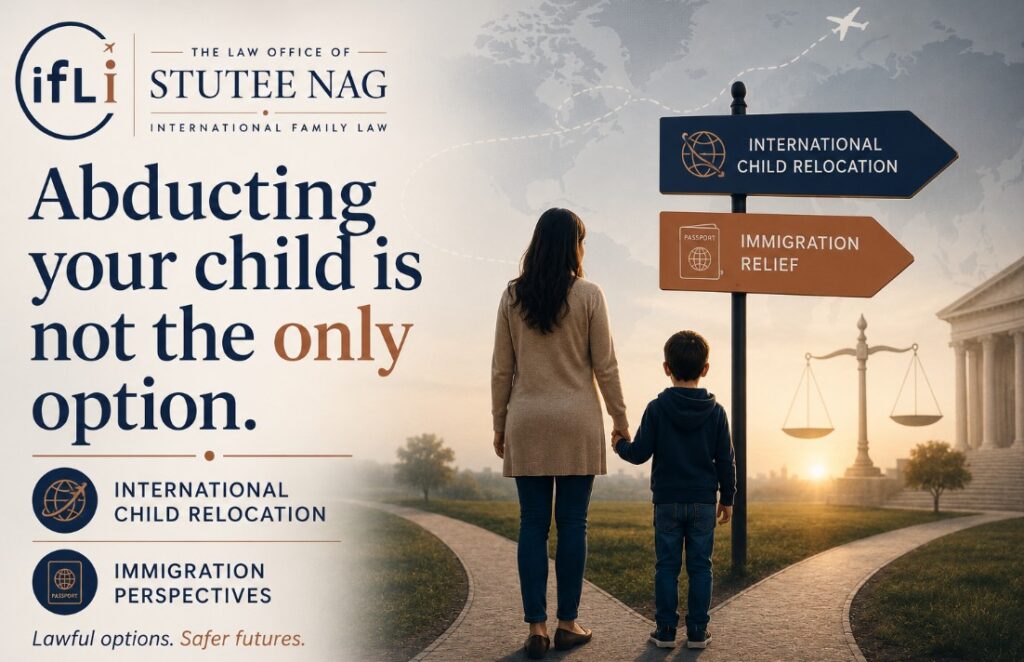
Understanding International Relocation, VAWA, U Visas, and Other Lawful Alternatives
International parental child abduction cases often arise at the intersection of family law, immigration law, and international treaties. Research suggests that allegations of domestic violence and intimate partner violence frequently appear in international parental child abduction cases involving mothers. Immigration related dependency often compounds the problem. A spouse who controls the family’s finances may also control the other parent’s immigration status, employment opportunities, access to transportation, and ability to communicate with family abroad. For some immigrant parents, remaining in the relationship can feel indistinguishable from remaining trapped.
However, allegations of domestic violence are not immune from dispute. In my own practice, I have encountered cases involving compelling evidence of abuse, cases where the allegations appeared to have been significantly exaggerated, and cases in which the accusations were vigorously denied.
This article does not attempt to determine whether any particular allegation of abuse is true or false. Instead, it addresses a more practical question.
If a parent genuinely believes that remaining in the relationship is no longer possible, is remaining in the United States still possible?
In many cases, the answer may be yes.
Before making an impulsive (and dare I say, illegal) decision that may trigger years of custody litigation, Hague Convention proceedings, or criminal consequences in some jurisdictions, parents should understand that other legal remedies may be available. Depending upon the circumstances, these may include seeking judicial approval for an international relocation, pursuing immigration relief that removes dependence upon an abusive spouse, or obtaining protective orders through the family courts.
Circumstances likely to lead to IPCA
International parental child abduction rarely begins with a desire to violate the law. Instead, it may result from:
Physical abuse. Emotional abuse. Financial abuse. Coercive control. Immigration related threats. Or, in many cases, it is simply the desire to get away from the other parent after the relationship has broken down.
However, removing a child from the United States without the consent of the other parent may violate existing custody orders or interfere with the other parent’s custodial rights, and may well result into a criminal proceeding against the taking parent. If the child is taken to or from a Hague Convention country, the removal may trigger proceedings under the Hague Convention on the Civil Aspects of International Child Abduction. Even where the destination is not a Hague Convention country, litigation may continue for years in multiple jurisdictions.
The emotional costs can be equally significant.
Children caught in international custody disputes frequently experience prolonged uncertainty, interrupted schooling, separation from one parent, and continuing conflict between adults whom they love. Even where a parent’s fears are genuine, unilateral action often creates new problems without necessarily resolving the original ones.
For that reason, parents should understand the lawful alternatives before concluding that international child abduction is their only option.
International Child Relocation
One of those alternatives is seeking judicial permission to relocate internationally with the child because the proposed move serves the child’s best interests after considering all of the relevant evidence.
International relocation cases are among the most heavily litigated matters in family law because they require courts to balance competing interests that are each fundamentally important. One parent may have legitimate reasons for wishing to relocate, including safety, employment, education, remarriage, proximity to extended family, or immigration concerns. The other parent has an equally legitimate interest in maintaining a meaningful relationship with the child. The court must determine whether those interests can be reconciled without sacrificing the child’s welfare.
There is no single national standard governing international relocation.
Child custody law is determined by each individual state. As a result, relocation standards vary considerably across the United States. Some states begin with a presumption that favors relocation by the primary residential parent. Others place the burden upon the moving parent. Still others require courts to begin from a completely neutral position and determine whether relocation advances the child’s best interests.
States That Favor Relocation
A small number of jurisdictions adopt statutory presumptions that make relocation comparatively easier.
Washington is perhaps the best known example. Under its Child Relocation Act, the law begins with a rebuttable presumption that relocation by the custodial parent should be permitted. The parent opposing the move bears the burden of demonstrating that the detrimental effects of relocation outweigh its benefits. Oklahoma follows a similar philosophy by recognizing a presumptive right of the primary custodial parent to relocate, subject to judicial review where the move would prejudice the child’s welfare.
These presumptions do not guarantee success. They simply determine which parent bears the initial burden of persuasion.
States That Place the Burden on the Moving Parent
Wisconsin places the burden upon the moving parent to establish that the proposed relocation is not unreasonable or contrary to the child’s best interests. Several other states have similar mechanisms in place.
States Applying a Neutral Best Interests Analysis
Many states reject presumptions altogether.
In Tennessee the court determines whether the proposed relocation is in the child’s best interests after weighing the statutory factors.
New York’s relocation jurisprudence is governed by the Court of Appeals’ landmark decision in Tropea v. Tropea. Rather than applying fixed rules, New York courts conduct an individualized analysis that examines the totality of the circumstances surrounding the proposed move. The relocating parent bears the burden of demonstrating that relocation will serve the child’s best interests. Among the considerations are the reasons for the move, the quality of each parent’s relationship with the child, educational opportunities, economic circumstances, the feasibility of preserving the relationship with the nonrelocating parent, and the overall impact upon the child’s quality of life.
New Jersey once followed a markedly different approach. For many years, the decision in Baures v. Lewis created a framework that generally favored relocation by the primary residential parent. In 2017, however, the New Jersey Supreme Court fundamentally changed course in Bisbing v. Bisbing. The Court eliminated the earlier presumption and held that relocation disputes should instead be decided under the same best interests analysis that governs other custody determinations. Today, New Jersey courts begin from a neutral position and closely examine factors including domestic violence, parental fitness, the child’s needs, each parent’s willingness to cooperate, and the practical realities of maintaining meaningful parenting time across international borders.
California and Florida likewise employ structured best interests analyses, although each uses its own statutory and judicial framework. California distinguishes between sole and joint physical custody when evaluating relocation requests, while Florida applies an eleven factor statutory test that considers, among other things, the anticipated improvement in the quality of life for both the parent and the child.
The Destination Country May Matter More Than the State
Although relocation standards differ from state to state, one consideration frequently transcends state boundaries: where the child is going.
A proposed move to another Hague Convention country presents different legal considerations from a proposed move to a country that has not joined the Convention.
When the destination country participates in the Hague Convention, courts know that legal mechanisms generally exist to seek the return of a child who is wrongfully retained and to encourage respect for custody rights across international borders. That does not mean relocation will automatically be approved, but it does reduce one of the court’s principal concerns.
The analysis becomes considerably more difficult when the proposed destination is a non Hague country. Some examples include India, China, the UAE, even Russia (which although a Hague signatory is not a treaty partner with the US).
Courts recognize that recovering a child from a country that is not bound by the Hague Convention may prove extraordinarily difficult if future custody disputes arise. They also consider whether United States custody orders are likely to be recognized or enforced in the destination country. In particularly complex cases, parties may present expert testimony addressing the foreign country’s custody laws and the practical enforceability of parenting arrangements.
For that reason, even states that are generally receptive to relocation may scrutinize international relocation petitions involving non Hague countries with exceptional care.
When Immigration Status Is Part of the Problem
Not every parent who contemplates leaving the United States does so because they wish to return home permanently. Sometimes the decision is driven by a mistaken belief that remaining in the country is legally impossible.
Immigration dependency is a common feature of abusive relationships involving noncitizen spouses. The abusive partner may repeatedly insist that divorce will result in immediate deportation, that the victim will never obtain lawful immigration status independently, or that the children will remain in the United States while the immigrant parent is forced to leave. Whether these statements are legally accurate is often beside the point. Their purpose is to create fear and dependence.
Congress recognized this problem when it enacted the Violence Against Women Act, commonly known as VAWA.
Who May Qualify Under VAWA?
Although its title suggests otherwise, VAWA is not limited to women. Its immigration provisions are available to qualifying victims regardless of gender and were designed to prevent abusive United States citizens and lawful permanent residents from using the immigration system as a tool of coercive control. By allowing eligible applicants to seek immigration relief independently, Congress removed one of the most powerful forms of leverage available to an abusive spouse.
A spouse may be eligible to file a VAWA self petition if the abusive spouse is either a United States citizen or a lawful permanent resident. The same protections may also extend to certain abused children and, in limited circumstances, abused parents of adult United States citizen children. The immigration status of the abuser is therefore critical because VAWA generally does not apply where the abusive spouse lacks lawful immigration status altogether.
The marriage itself must also have been entered into in good faith.
USCIS distinguishes between marriages formed for genuine family reasons and marriages entered into solely for immigration benefits. Applicants are therefore expected to demonstrate that the relationship was authentic through documents and other evidence reflecting a shared life together. Joint financial records, photographs, correspondence, children’s birth certificates, residential records, insurance policies, and statements from individuals familiar with the marriage frequently become important pieces of evidence.
Applicants must also establish good moral character. Although minor infractions do not necessarily preclude relief, serious criminal conduct may affect eligibility and should always be evaluated with experienced immigration counsel.
Battery or Extreme Cruelty
One of the most misunderstood aspects of VAWA concerns the meaning of abuse. Many people assume that VAWA requires repeated physical assaults. The statute is considerably broader. Physical violence certainly qualifies. So does sexual abuse. Equally important, however, immigration law recognizes that abuse may occur without visible injuries. Severe emotional abuse, coercive control, financial domination, isolation from family and friends, threats involving immigration status, intimidation, and other forms of extreme cruelty may satisfy the statutory standard depending upon the facts of the individual case.
This broader understanding reflects the reality that abusive relationships often involve patterns of control rather than isolated incidents of physical violence.
Does Divorce Prevent a VAWA Petition?
Not necessarily. A divorced spouse may qualify for VAWA relief provided the self petition is filed within two years of the divorce and the remaining statutory requirements are satisfied.
The VAWA Self Petition
The principal mechanism for obtaining immigration relief under VAWA is the self petition filed on Form I 360. The significance of the self petition cannot be overstated.
Ordinarily, many family based immigration processes require the participation of the petitioning spouse. VAWA removes that dependency. The applicant files independently, without requiring the abusive spouse’s consent, signature, or continued cooperation. Indeed, one of the central purposes of the statute is to ensure that an abusive spouse cannot sabotage the victim’s immigration case by refusing to participate.
The confidentiality provisions of VAWA provide an additional safeguard. USCIS generally does not disclose the filing to the abusive spouse, thereby reducing the likelihood that the immigration process itself becomes another instrument of abuse.
Prima Facie Determinations
A prima facie determination is a preliminary finding that the submitted evidence appears sufficient to establish basic eligibility under VAWA. Although temporary and subject to further review, it may permit applicants to access certain public benefits while USCIS continues evaluating the petition.
Employment Authorization and Deferred Action
Economic independence is frequently one of the greatest challenges facing victims of domestic violence. VAWA addresses that concern by allowing qualifying applicants to obtain employment authorization once the statutory requirements are met. A work permit may enable an applicant to obtain lawful employment, establish financial independence, secure housing, and support both themselves and their children without relying upon the abusive spouse.
Approval of a VAWA petition may also result in deferred action, meaning that the federal government generally refrains from pursuing removal while the applicant continues through the immigration process. Deferred action is not equivalent to permanent immigration status, but it often provides an important measure of stability during an otherwise uncertain period.
A Path Toward Permanent Residence
For many applicants, VAWA represents more than temporary protection.
Where the abusive spouse is a United States citizen, an approved self petition may permit the applicant to apply immediately for lawful permanent residence if the remaining legal requirements are satisfied. Where the abusive spouse is a lawful permanent resident, visa availability may affect when adjustment of status can occur because immigrant visa numbers remain subject to federal immigration quotas.
The precise timing varies considerably from case to case and depends upon numerous immigration factors beyond the scope of this article. Nevertheless, the important point remains the same. An abusive spouse does not necessarily control the victim’s future immigration status.
Conditional Permanent Residents
VAWA also protects certain immigrants who already possess conditional permanent residence through marriage.
Ordinarily, conditional permanent residents must jointly file a petition with their spouse to remove the conditions on residence. An abusive spouse may exploit that requirement by refusing to cooperate unless the victim remains in the relationship.
VAWA addresses this problem through the battered spouse waiver.
Instead of filing jointly, an eligible applicant may seek removal of the conditions independently by demonstrating that the statutory requirements have been satisfied. This prevents the abusive spouse from using immigration status as leverage to force continued cohabitation or reconciliation.
VAWA Cancellation of Removal
Some victims first learn about VAWA only after removal proceedings have already begun.
For individuals who are already before an Immigration Judge, VAWA may provide an additional form of relief known as cancellation of removal. Unlike ordinary cancellation of removal, which generally requires ten years of continuous physical presence in the United States, VAWA cancellation applies a different statutory framework and requires only three years of physical presence together with the remaining eligibility requirements established by Congress.
When VAWA Is Not Available
VAWA is an important remedy, but it is not universal.
If the abusive spouse is neither a United States citizen nor a lawful permanent resident, a VAWA self petition will generally not be available because the qualifying relationship requirement has not been satisfied.
That does not necessarily end the analysis.
The U Visa
Some victims of domestic violence may instead qualify for a U Nonimmigrant Visa.
Unlike VAWA, the U Visa does not depend upon the immigration status of the abuser. Instead, eligibility focuses upon whether the applicant was the victim of certain qualifying criminal activity committed in the United States and whether the applicant has been, is being, or is likely to be helpful to law enforcement authorities investigating or prosecuting that criminal conduct. Domestic violence, felony assault, and stalking are among the qualifying offenses identified by Congress.
A critical component of every U Visa application is the required certification from a qualifying law enforcement agency, prosecutor, judge, or other authorized official confirming the applicant’s helpfulness in the investigation or prosecution of the crime. Without that certification, the application generally cannot proceed.
Although U Visa processing times have become lengthy because of statutory limits on the number of visas issued each year, successful applicants may ultimately obtain lawful status, employment authorization, and, after satisfying additional statutory requirements, become eligible to apply for lawful permanent residence.
Conclusion
International parental child abduction cases often occur during periods of intense stress, when a parent fears for their safety or believes that returning to their home country with the child is the only realistic solution. In some cases those concerns are well founded; in others they stem from misunderstandings about custody law, immigration law, or both. Once a child is removed across international borders without the other parent’s consent or court authorization, however, the legal issues shift dramatically. Instead of considering a proposed relocation, courts may be required to determine whether the removal was wrongful, potentially leading to years of litigation involving jurisdiction, treaty obligations, custody rights, and international enforcement. None of this suggests that an abused parent should remain in an unsafe relationship. Rather, it underscores the importance of obtaining legal advice before making an irreversible decision. Depending on the circumstances, a parent may be able to seek judicial approval for international relocation, pursue immigration relief such as VAWA or a U Visa, obtain emergency protective orders, or seek temporary custody. While no remedy is guaranteed and each has its own legal requirements, exploring these options before crossing international borders may prevent years of avoidable litigation and allow families to pursue safety through lawful means.