
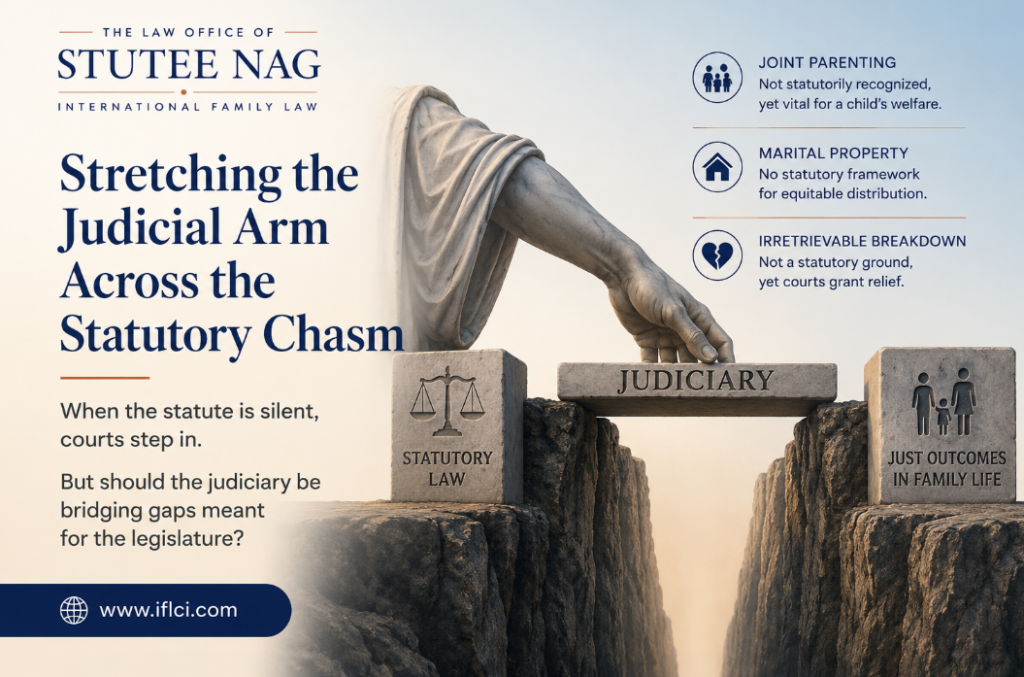
What happens when the outcome that a court considers desirable is not a remedy that the legislature has actually built into the statutory framework?
A recent judgment of the Bombay High Court raises a much larger question about Indian matrimonial law. In Dolan Acharya v. Snehasis Rashbihari Batabyal, the Bombay High Court made an interesting observation:
“In Indian law, the statutory framework governing child custody and guardianship does not recognise the concept of joint parenting.”
The Court emphasized that there is no concept of compelling equal parenting: the legal foundation remains the welfare of the child, rather than competing parental rights.
The Court did not reject joint parenting. Quite the contrary. It explained what a meaningful joint parenting arrangement should look like, meaningful participation by each parent in decision-making, sufficient high-quality time with both parents, and careful consideration of the child’s education, health, extracurricular activities and emotional stability. It cautioned only that a mechanical 50:50 division may be impractical and generate further conflict.
Indeed, the Court went so far as to say that a shared or joint parenting plan, “if found to be in the best interests of the child, would be the best solution,” while emphasizing that Indian statutory law does not recognise such a concept.
That creates an interesting jurisprudential problem.
Joint parenting is one example. But it is hardly the only one in Indian matrimonial law.
Consider marital property.
Unlike many jurisdictions, Indian matrimonial statutes do not provide a comprehensive regime for identifying and equitably distributing marital assets upon divorce. Yet modern marriages routinely involve homes, investments, businesses and other assets accumulated through years of financial and non-financial contributions by both spouses.
Courts are then confronted with the consequences of a marriage without necessarily having a statutory mechanism equivalent to equitable distribution through which those economic consequences can comprehensively be resolved.
Or consider irretrievable breakdown of marriage.
For most litigants, simply establishing that a marriage has irretrievably collapsed does not itself provide an ordinary statutory ground for divorce. And yet courts encounter marriages that have plainly ceased to exist in every meaningful sense, sometimes after years, or decades, of separation and litigation.
The Supreme Court has had to address that reality through its extraordinary constitutional powers. But that itself demonstrates the underlying problem: the judiciary is being asked to solve a social and legal problem for which the ordinary statutory framework has not supplied an adequate remedy.
There is a common thread running through all three examples.
Joint parenting.
Marital-property distribution.
Irretrievable breakdown.
These are not unusual features of modern family life. Yet the statutory architecture does not always expressly provide the tools necessary to deal with them.
Courts then inevitably try to bridge the distance between the law as enacted and the family as it actually exists—through welfare jurisdiction, interpretation, inherent or constitutional powers, and judge-made principles.
Sometimes that judicial flexibility is indispensable. It may even produce the fairest result available.
But it raises a more fundamental institutional question:
How far can—and should—the judicial arm be extended to fill a legislative vacuum?
Because there is ultimately a difference between interpreting a statutory remedy broadly and having to construct a remedy because the statute never supplied one in the first place.
Perhaps the real lesson from the Bombay High Court’s observation is therefore larger than joint parenting.
Indian family law has evolved enormously through judicial intervention.
The question is whether, on some of these issues, it is time for the statute to catch up with the jurisprudence.