
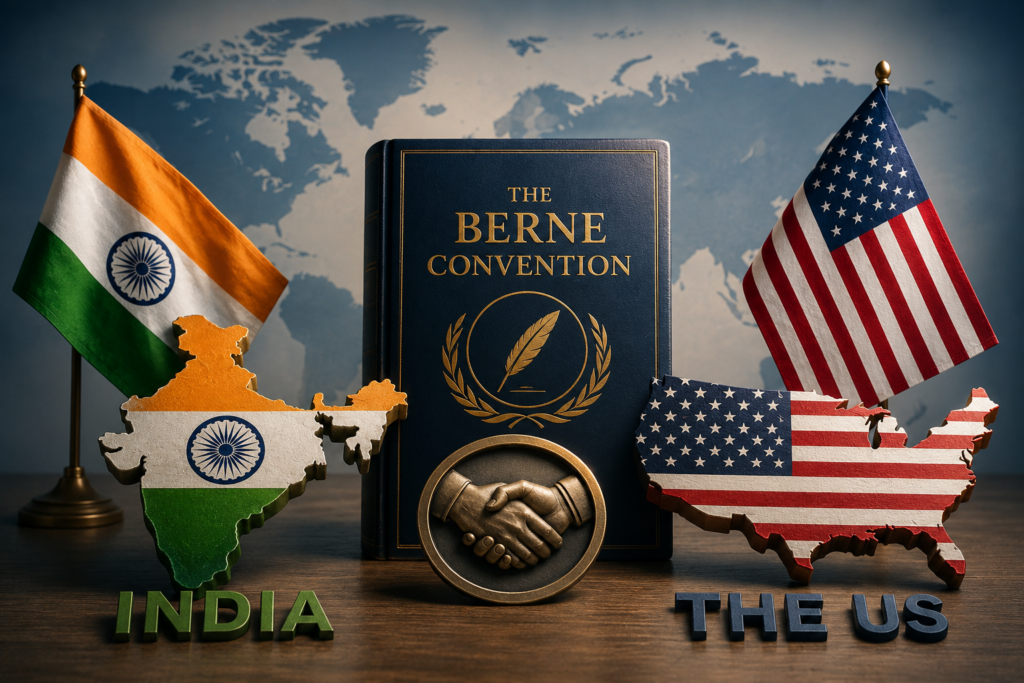
For more than a century, the Berne Convention has been celebrated as the cornerstone of international copyright protection. It promises a deceptively simple bargain: a copyright owner should not lose protection merely because a work crosses an international border. A song composed in New York receives copyright protection in India without any registration. A novel first published in Mumbai enjoys the same automatic protection in the United States. On paper, the system appears elegantly reciprocal.
In practice, however, reciprocity is only the beginning of the story. The Berne Convention equalizes legal entitlement, not the practical experience of enforcing that entitlement. Copyright remains territorial. Once infringement occurs, every dispute is ultimately governed by the institutions, procedures, evidentiary rules, judicial culture, and policy choices of the country in which enforcement is sought. That distinction often comes as a surprise to creators and businesses who assume that an international treaty has harmonized copyright protection across borders.
The relationship between the United States and India illustrates this distinction particularly well. Both countries are long-standing members of the Berne Union. Both recognize copyright automatically without registration. Both provide civil and criminal remedies against infringement. Yet the path from possessing a copyright to successfully enforcing it can look markedly different in each jurisdiction.
The Berne Convention’s principle of national treatment is frequently misunderstood as a promise of equivalent protection. It is not. It simply requires each member state to treat foreign authors no less favorably than its own nationals. A U.S. copyright owner in India receives the same legal treatment as an Indian copyright owner, not the same enforcement experience that the owner might have expected in a U.S. federal court. Likewise, an Indian creator litigating in the United States must navigate American procedural rules, discovery obligations, evidentiary standards, and litigation costs. Equality before the law is not necessarily equality in the speed, predictability, or commercial value of the remedy.
The same disconnect exists with Berne’s prohibition on formalities. Legally, neither a U.S. work nor an Indian work requires registration to enjoy copyright protection in the other country. Yet experienced practitioners routinely advise clients to maintain clear documentary evidence of ownership, registrations where available, licensing records, and dated evidence of creation. Not because the treaty demands it, but because practical enforcement often does. Whether dealing with customs authorities, online intermediaries, local enforcement agencies, or urgent applications for interim relief, documentary certainty frequently accelerates a process that the Convention itself never sought to regulate.
The divergence becomes even more apparent when the conversation shifts from rights to exceptions. Berne deliberately leaves member states room to craft their own limitations on copyright protection. The United States developed the open-ended doctrine of fair use through decades of judicial interpretation. India adopted a detailed statutory framework of fair dealing and specific legislative exceptions. Neither system is inherently more protective than the other; they simply reflect different legislative choices. The consequence, however, is that conduct viewed as infringing in one jurisdiction may fall within a statutory exception in another, despite both countries faithfully operating within the Berne framework.
Even enforcement mechanisms tell only part of the story. India has developed an increasingly sophisticated body of copyright jurisprudence, with specialized commercial courts, dynamic injunctions against online piracy, John Doe orders, and both civil and criminal remedies available in appropriate cases. At the same time, commercial realities often shape enforcement strategy as much as legal doctrine. Rights holders must weigh litigation timelines, costs, evidentiary burdens, business relationships, cross-border recovery of damages, and the practical value of interim relief before deciding how, or whether, to pursue infringement.
Perhaps that is the Convention’s greatest paradox. Berne has been extraordinarily successful in making copyright travel across borders. What it has never attempted to do is make justice travel with it. The Convention harmonizes the existence of rights, but not the institutions responsible for protecting them. For international creators and businesses, understanding that distinction is often as important as understanding copyright law itself.